My wife had acid reflux for a couple of years and we were looking for ways to try and figure out what was causing it.
She tried a couple of apps. They were either too generic — basically a food diary with a wellness spin — or too clinical, designed to impress a gastroenterologist rather than help someone work out why Tuesday was fine and Wednesday wasn’t. Nothing really mapped to the actual question she was trying to answer: what is it, specifically, that sets this off?
So I built (vibe coded) something.
Reflux Radar is a small iOS app. You type what you ate — a meal, a snack, whatever — and an AI parses the ingredients and colour-codes them: green for alkaline, amber for borderline, red for acidic. It’s not a diagnosis. It’s a prompt and, importantly, a way of seeing, at a glance, how a meal sits in terms of pH.
Alongside the food log there’s a separate symptom tracker — chest pain, cough, stomach ache, reflux — so you can record what happened after eating without conflating the input with the output. Everything sits on a daily timeline. The idea is that patterns become visible over time: not just what you ate, but when, and what followed.
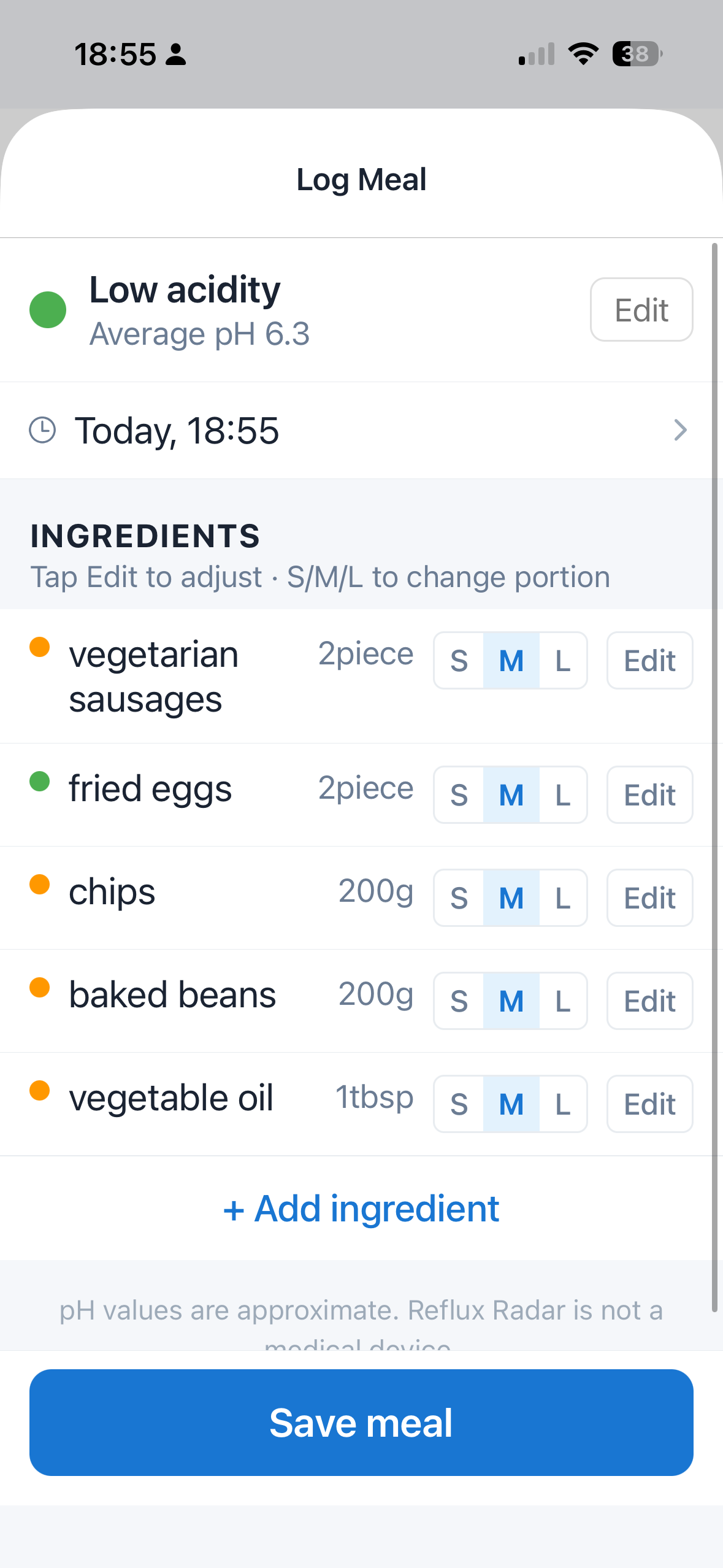
That was the theory and we’re really happy with the results. It works. It helped my wife identify a few foods she’d overlooked, and confirmed that certain foods just agreed with her.
Building it was quite the experience. Some things came together faster than expected — the AI parsing works well, better than I thought it would. The colour-coding logic took more iteration. The timeline view went through several versions before I was happy with it.
One deliberate decision: the app is local-only for now. No accounts, no cloud, no data leaving the device. This is health data. I didn’t want to build infrastructure I’d then feel obliged to maintain. It’s built in React Native with Expo, and I’m approaching App Store submission.
I don’t know if it’ll be useful to anyone else. It’s already been useful to my wife. That feels like a reasonable place to start.
 abstractlines
Leave a comment